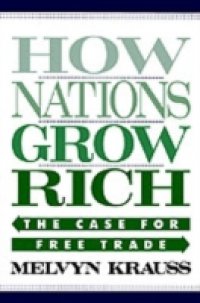
How Nations Grow Rich: The Case for Free Trade

Krauss Melvyn (EN)
Рейтинг 0
  • Понравилось: 0
  • В библиотеках: 0
  • 37
  • 0
  • 0

Скачать книгу в формате:

Аннотация

There can be no doubt, writes economist Melvyn Krauss, that the prosperity of the industrial nations since the Second World War has been due largely to global specialization and interdependence. No one country does all tasks today -- products are designed in one country, produced in another and assembled in a third. The increased standard of living resulting from global specialization in turn has led to the growth of the modern welfare state, including an increased demand for economic security and social measures which guarantee politically-determined minimum consumption standards for citizens. Ironically, says Krauss, as the debate over the North American Free Trade Area (NAFTA), the General Agreement of Tariffs and Trade (GATT) and the recently established World Trade Organization demonstrate, today's welfare state has evolved into a protectionist state. U.S. consumer advocates (Ralph Nader) see free trade as a threat to consumerist legislation. U.S. environmentalists (Jerry Brown) see free trade as a threat to environmental legislation. U.S. human rights advocates (Anna Quindlin) see free trade as a threat to human rights abroad. In How Nations Grow Rich, Krauss argues there is no inherent reason why the growth of the welfare state in the Western industrial countries should conflict with free trade that is, there is no inherent reason for the welfare state to be protectionist. Exposing fallacious &quote;welfare state&quote; arguments for protection, Krauss makes a powerful case for free trade in general, and NAFTA in particular, as mechanisms for raising U.S. living standards. Americans are made better off through a reallocation of U.S. productive resources from lower-to-higher productivity uses--from textiles to computers, for example. Moreover, by raising wages in Mexico relative to the U.S., Krauss expects NAFTA to help reduce both legal and illegal immigration. Were states like California to reduce their generous social services and affirmative action programs, labor immigration from Mexico would fall to politically acceptable levels. Krauss' novel insight that migration and foreign trade are alternative means of effectuating international exchange is used in this lively and informative book to shed light on a host of important policy issues. By the very act of restricting textile and apparel imports, the U.S. virtually compels foreign textile workers to migrate to the U.S. The European Union's tariff against East European exports provokes a flood of Eastern workers to Western Europe. In How Nations Grow Rich, Krauss dispatches both traditional and newer arguments for protection with unusual verve and clarity. Addressing the belief that protectionism boosts employment, he points out that import restrictions can destroy U.S. jobs when imposed on materials we use as parts. For example, in 1991, Apple and Toshiba suffered a dramatic increase in their production costs as a result of a 63% tariff on imported Japanese flat-panel display screens. This &quote;protect-America&quote; policy backfired, causing these two mega-companies to move their production facilities abroad. In response to protectionist demands that the U.S. close its markets until Japan reduces its trade barriers against U.S. goods--that trade be fair before it can be free--Krauss points out that in a market economy where consumers are kings, only a consumer-based equity standard is valid. Thus what the &quote;fair trade&quote; protectionist argument really comes down to is the nonsensical proposition that because foreign countries damage their consumers by foolish protectionist measures, equity demands the United States follow suit. This wide-ranging and stimulating book clarifies such important and often inaccessible issues as development policy, foreign aid, trade sanctions, child labor, human rights trade linkages, immigration, European Monetary Union and affirmative action trade policies. How Nations Grow Rich is must reading for anyone concerned with public policy and international economics.


ЕЩЕ


Отзывы

Популярные книги

Читатель! Мы искренне надеемся, что ты решил читать книгу "How Nations Grow Rich: The Case for Free Trade" Krauss Melvyn (EN) по зову своего сердца. По мере приближения к исходу, важным становится более великое и красивое, ловко спрятанное, нежели то, что казалось на первый взгляд. Написано настолько увлекательно и живо, что все картины и протагонисты запоминаются на долго и даже спустя довольно долгое время, моментально вспоминаются. Создатель не спешит преждевременно раскрыть идею произведения, но через действия при помощи намеков в диалогах постепенно подводит к ней читателя. На протяжении всего романа нет ни одного лишнего образа, ни одной лишней детали, ни одной лишней мелочи, ни одного лишнего слова. Произведение, благодаря мастерскому перу автора, наполнено тонкими и живыми психологическими портретами. Значительное внимание уделяется месту происходящих событий, что придает красочности и реалистичности происходящего. Замечательно то, что параллельно с сюжетом встречаются ноты сатиры, которые сгущают изображение порой даже до нелепости, и доводят образ до крайности. Автор искусно наполняет текст деталями, используя в том числе описание быта, но благодаря отсутствию тяжеловесных описаний произведение читается на одном выдохе. Динамичный и живой язык повествования с невероятной скоростью приводит финалу и удивляет непредсказуемой развязкой. Отличный образец сочетающий в себе необычную пропорцию чувственности, реалистичности и сказочности. "How Nations Grow Rich: The Case for Free Trade" Krauss Melvyn (EN) читать бесплатно онлайн будет интересно не всем, но истинные фаны этого стиля останутся вполне довольны.

Читать How Nations Grow Rich: The Case for Free Trade

Новинки

Мир Мертвых
  • 2
  • 0
  • 0

Аннотация:

От Манхэттена до Бронкса, от Квинса до Бруклина - это настоящий ад, населенный ходячими мертвецам...

Полный текст — 65 стр.

От Манхэттена до Бронкса, от Квинса до Бруклина - это настоящий ад, населенный ходячими мертвецам...

По экрану памяти: Воспоминания о Второй Колымской экспедиции, 1930—1931 гг. Книга вторая
  • 7
  • 0
  • 0

Аннотация:

Герой Социалистического Труда, участник Первой Колымской экспедиции, руководитель Второй, Третьей...

Полный текст — 59 стр.

Герой Социалистического Труда, участник Первой Колымской экспедиции, руководитель Второй, Третьей...

По экрану памяти: Воспоминания о Второй Колымской экспедиции, 1930—1931 гг. Книга первая
  • 6
  • 0
  • 0

Аннотация:

Герой Социалистического Труда, участник Первой Колымской экспедиции, руководитель Второй, Третьей...

Полный текст — 48 стр.

Герой Социалистического Труда, участник Первой Колымской экспедиции, руководитель Второй, Третьей...

Хороший муж
  • 18
  • 0
  • 0

Жанр: Разное

Аннотация:

Муж Эллен был таким тихим и скромным, что она почти могла представить, как он извиняется за надпи...

Полный текст — 1 стр.

Муж Эллен был таким тихим и скромным, что она почти могла представить, как он извиняется за надпи...

Я так хочу. Распаковать свои желания и открыть тот секс, о котором хочется кричать
  • 14
  • 0
  • 0

Аннотация:

Секс – источник стресса. Это связано с тем, что такая тонкая и чувствительная область нашей жизни ок...

Полный текст — 182 стр.

Секс – источник стресса. Это связано с тем, что такая тонкая и чувствительная область нашей жизни ок...

Ее муж – Homo habilis
  • 12
  • 0
  • 0

Аннотация:

Эта повесть получила премию "Локус" в 1984 году. Она также была номинирована на премию "Небьюла" ...

Полный текст — 32 стр.

Эта повесть получила премию "Локус" в 1984 году. Она также была номинирована на премию "Небьюла" ...

Ускорение
  • 7
  • 0
  • 0

Аннотация:

Цивилизации являются продуктом исторической преемственности: знания, традиции и технологии развив...

Полный текст — 14 стр.

Цивилизации являются продуктом исторической преемственности: знания, традиции и технологии развив...